
Getting the Most Out of Eco-Worthy 100W Bifacial Panels With Bluetti AC180
I’ve been using a pair of Eco-Worthy 100W 18V bifacial solar panels with my Bluetti AC180, and the setup has been consistently reliable and efficient. Beyond just plugging them in, there are several ways to optimize output — including tilt, placement, and taking full advantage of the bifacial design.
The short answer: Two Eco-Worthy 100W bifacial panels work well with the Bluetti AC180 when they are connected within the power station’s voltage and current limits. In my fixed 28-degree setup, the pair generally produces about 160 to 180 watts in strong sunlight and around 80 to 100 watts under cloudy conditions. Actual output varies with sun angle, temperature, shading, panel cleanliness and how much reflected light reaches the rear of the panels.
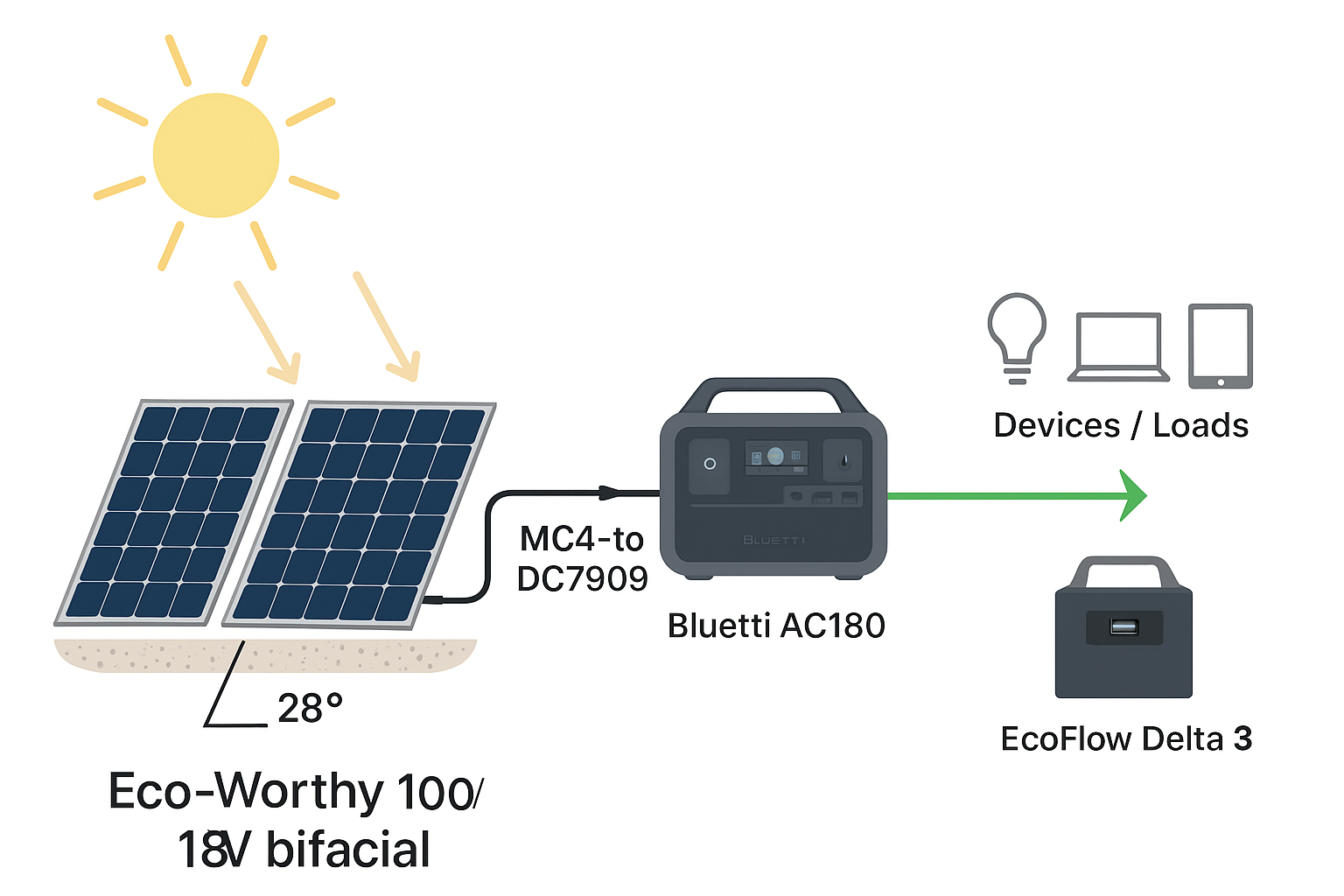
Equipment Used in My Setup
- Two Eco-Worthy 100W 18V bifacial solar panels
- MC4 branch connectors for the parallel connection
- Bluetti-compatible MC4-to-DC7909 solar charging cable
- Bluetti AC180 portable power station
- Fixed panel mounting structure set at approximately 28 degrees
Why These Panels Are Great
Each Eco-Worthy 100W panel offers:
- Rated Output: 100W per panel
- Voltage: 18V (Vmp)
- Current: ~5.5A (Imp)
- Bifacial Design: Captures sunlight from the rear side, with the actual benefit depending on rear clearance, shading, surface reflectivity and sun angle.
- Durability: Tempered glass front and back for solid construction, ideal for outdoor use.
The bifacial feature allows the panels to pick up light reflected from surfaces beneath them, such as concrete, gravel, or snow. Bifacial gains vary with mounting height, rear-side shading, surface reflectivity and sun angle. I have seen good total output from this setup, but I have not separately measured front-side and rear-side production. Because of that, I cannot assign a precise percentage of my output to the rear side of the panels alone.
Connecting to the Bluetti AC180
The Bluetti AC180 features a DC7909 barrel connector for solar input. Bluetti includes a MC4-to-DC7909 adapter, allowing you to connect MC4-equipped panels directly with no additional parts. The AC180’s MPPT controller ensures efficient power conversion from the panels to charge the battery.
Key Specs of the AC180 Solar Input
- Max Input Power: 500W
- Voltage Range: 12V–60V
- Max Current: 10A
How I Connected the Two Panels
I connected the two Eco-Worthy panels in parallel using MC4 branch connectors, then connected the combined output to the Bluetti AC180 through its MC4-to-DC7909 solar charging cable. In a parallel configuration, the operating voltage remains approximately the same as a single panel, about 18 volts in this setup, while the available current from the two panels is combined.
Each panel is rated at approximately 5.5 amps at its operating point, so the pair can make roughly 11 amps available under ideal conditions. The Bluetti AC180 accepts up to 10 amps from its solar input, which means the power station may limit the current it draws when the panels are producing at their best. The panels do not force excess current into the AC180; the charge controller determines how much current it accepts.
Readers should verify the voltage, current, connector polarity and input limits for their own panels and power station rather than copying this configuration without checking their equipment. It is also worth checking each panel’s open-circuit voltage against the power station’s input range, since that voltage is different from normal operating voltage.
Optimal Tilt and Orientation
I currently have the panels fixed at approximately 28 degrees. That angle has worked well as a practical year-round compromise for my location, although the ideal angle changes by season and depends on whether the goal is maximum annual, summer or winter production. Here’s how to fine-tune your setup for better real-world output:
- Seasonal Adjustments
- Summer: Slightly lower tilt for higher sun angles
- Winter: Increase tilt for lower sun angles
- Sun Tracking
- Use a manual adjustable stand to rotate panels throughout the day.
- Repositioning portable panels during the day can improve total production, especially when the original orientation is optimized mainly for midday. The actual improvement varies with the season, starting orientation, shading and how often the panels are moved.
- Bifacial Gain Optimization
- Place over reflective surfaces (white gravel, concrete, or snow)
- Elevate slightly off the ground to let light reach the rear side
Performance Observations
With the two panels fixed at approximately 28 degrees, connected in parallel with MC4 branch connectors, and feeding the Bluetti AC180 through the MC4-to-DC7909 solar charging cable:
- Peak Sun: ~160–180W combined input
- Cloudy Days: 80–100W output
- Efficiency Notes: MPPT controller handles minor shading or angle imperfections gracefully
Tips for Maximum Solar Output
- Keep panels clean from dust, leaves, or debris
- Adjust tilt seasonally for sun height changes
- Leverage reflective surfaces beneath panels for bifacial gain
- Elevate panels slightly off the ground
- Leave space between panels if adding more to avoid shading
Key Takeaways
- Two Eco-Worthy 100W bifacial panels can be a practical match for the Bluetti AC180 when their voltage and current remain within its solar-input limits.
- My two-panel setup commonly produces approximately 160 to 180 watts in strong sunlight rather than the full theoretical 200 watts.
- Panel angle, orientation, shading and cleanliness all affect real-world output.
- The fixed 28-degree mounting angle has worked well for my installation, but it is a year-round compromise rather than a universally optimal setting.
- Bifacial output depends heavily on rear clearance and reflected light, and I have not separately measured the rear-side contribution.
- My two panels are connected in parallel, which keeps voltage near the single-panel level while combining available current.
Frequently Asked Questions (FAQ)
Q1: Can I connect more than two Eco-Worthy 100W panels to the Bluetti AC180?
Yes, as long as the total input does not exceed 500W and voltage stays within 12–60V.
Q2: Do the panels work on cloudy days?
Yes. In my setup, the two panels have produced about 80 to 100 watts under cloudy conditions, but that is an observation from my installation rather than a guaranteed output level.
Q3: How does the bifacial design help?
It captures light from both sides, but the gain depends on rear clearance, rear-side shading, surface reflectivity and sun angle. I have not separately measured the rear-side contribution, so I cannot assign a precise percentage to it.
Q4: Is 28° the optimal tilt?
It has worked well as a practical year-round compromise for my setup, but it is not a universal optimum. The ideal angle changes by season and depends on whether you are optimizing for annual, summer or winter production.
Q5: Can I track the sun during the day?
Yes. Repositioning portable panels during the day can improve total production, especially when the original orientation is optimized mainly for midday. The actual improvement varies with the season, starting orientation, shading and how often the panels are moved.
Q6: Do I need extra adapters?
For my two-panel setup, I used MC4 branch connectors to combine the panels in parallel, then connected that output to the Bluetti AC180 through the Bluetti-compatible MC4-to-DC7909 solar charging cable.
Q7: How to maximize bifacial gain?
Elevate panels slightly, use reflective surfaces, and ensure rear side is unobstructed.
Q8: How do I maintain the panels?
Wipe the glass occasionally to remove dust or debris and avoid shading for peak efficiency.
Final Thoughts
The Eco-Worthy 100W bifacial panels paired with the Bluetti AC180 have been a strong portable solar solution in my original two-panel setup. Fixed at approximately 28 degrees, they have worked well as a year-round compromise, and small adjustments to tilt, elevation, cleanliness and reflected light can improve real-world output. The parallel MC4 branch connection and Bluetti-compatible MC4-to-DC7909 solar charging cable made the setup practical while keeping the operating voltage within the AC180’s solar input range.
Looking Ahead: I also have an EcoFlow Delta 3 that I plan to integrate into this solar setup. By adding the Delta 3, I’ll be able to expand my battery capacity, charge multiple devices simultaneously, and make even better use of my panels’ output, especially on days with strong sunlight. Combining both power stations will create a more flexible and resilient solar power system, perfect for extended off-grid use or heavy energy demands.




3 thoughts on “Getting the Most Out of Eco-Worthy 100W Bifacial Panels With Bluetti AC180”